Artificial Intelligence, commonly referred to as AI, has been one of the primary talking points of the last few years. While some are hopeful of a brighter future brought on by this technology, others remain worried about the grim expectations that AI can have on the changing world to come.
While tech companies love to shout about the benefits of AI, AI will likely be detrimental to the future of mankind.
Microsoft founder, Bill Gates, made headlines in 2025 when he made the bold prediction that AI would replace teachers. While it is unclear if AI will ever truly have the capability to replace teachers, one thing is clear: Artificial Intellience has made it more challenging for teachers tasked with educating students today.
BIC English teacher Makensie Walker explained how difficult Artificial Intelligence can make the jobs of teachers.
“AI makes it really hard to delineate between students that are improving and students that are cheating. With advanced tools like AI, students are able to cut corners, which hurts their learning skills that will be applicable in the future,” said Walker.
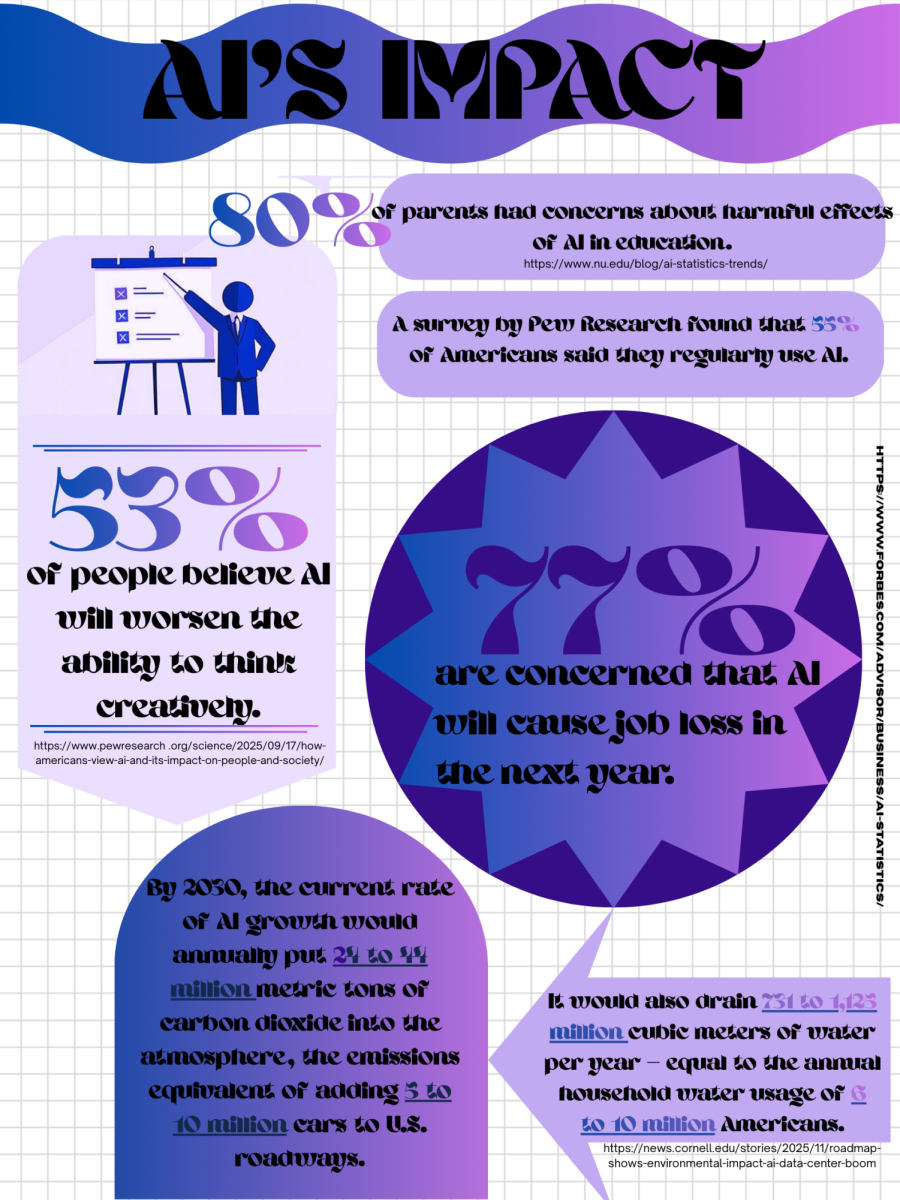
Data about AI backs up Ms. Walker’s claims. According to one study by Education Week, half of the students agree that using AI in class makes them feel less connected to their teachers. A decrease in peer-to-peer connections as a result of AI use is also a concern for teachers (47%) and parents (50%), according to the report. AI is not only creating poor social skills in our kid’s, but it’s also fabricating an education crisis.
The impact of AI on education is hard to fully understand right now, but it is a net negative for students today. Students can simply upload a photo of their assignment, only for AI to spit out the answer, no thinking involved. It is tremendously difficult for teachers to determine what writing is genuinely the work of their students, and what writing is simply AI generated in a matter of minutes. It is feasible that in 2026 a student could go through high school having never written an essay for themselves.
Not only can AI cause potentially catastrophic results in education, it also takes valuable resources. Generating one singular image from AI consumes the same amount of energy as charging a smartphone to full power. AI data facilities are putting a tremendous strain on local energy infrastructure, and drawing a tremendous amount of power. It is estimated that by 2050 AI growth would put up to 44 million metric tons of carbon dioxide into the atmosphere, according to Cornell university. This is only worsening the threats of global warming. AI was created for good and intentional purposes, but it quickly became a threat to not only students and the American people, but also to the environment and the world as we know it.
While AI currently feels inevitable, there are solutions to the problems it causes. It is imperative that our government officials regulate AI by reducing the use of AI in schools rather than encouraging it, and enact legislation that controls the carbon emissions created by this dangerous technology. The consequences of AI must be reigned in before it is too late.